Baldemar Zulz
The Zone of InterestBaldemar Zulz is a professor and honorary SS colonel whose medical authority, cultivated intellect, and participation in the camp’s machinery of persecution sit in deliberate tension. He invokes classical healers and scientific credentials, helps conduct selections, and advises Paul Doll on deceiving arriving deportees. Yet he also recognizes when the deception is failing and urges Doll to leave the ramp. His presence makes expertise part of the camp’s violence, while his moments of apparent concern expose the uneasy intimacy among its administrators.
Identity and Institutional Role
Zulz appears among the medical men who serve the camp, and his title gives him authority in discussions of health, selection, and the management of transports. At a meal with Doll and Suitbert Seedig, he is described as possessing the unsettling agelessness associated with certain medical men. The description places him between professional respectability and menace: his credentials belong to a world of medicine, but his work takes place within a system that sorts and abuses people.
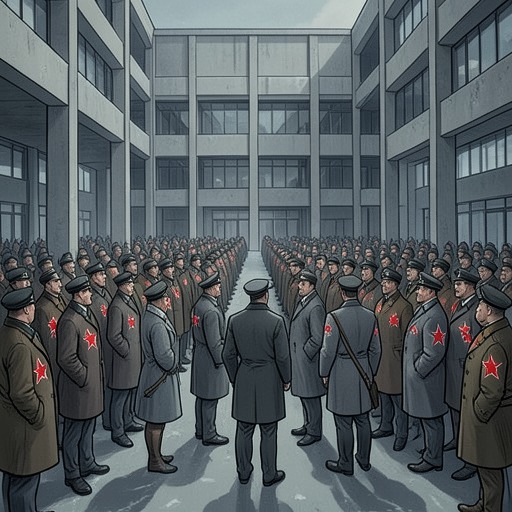
His role in selection is made concrete when a new transport arrives. Eight hundred men, women, and children are still moving around in the slush when panic breaks out; Zulz and his colleagues have not yet begun their selection. After ninety minutes of violence, about six hundred survivors have been forced into Red Cross vans and ambulances. The account does not make Zulz the cause of the disorder, but it locates him and his team within the process that is about to sort the arrivals. Elsewhere, the arriving groups are described as containing many children under ten and adults over sixty, while some of the young adults are already marked out by pregnancy, a club foot, spinal braces, or white sticks. Selection is thus not an abstract medical exercise: it takes place among visibly vulnerable people, under the authority of men such as Zulz.
Learning as an Ideology of Power
Zulz turns education into evidence for the regime’s supposed superiority. At dinner, he praises Heinrich Himmler’s work in ethnology through the Ahnenerbe and lists the specialists assembled around that project, including anthropologists, archaeologists, runologists, and heraldists. His account presents the accumulation of expertise as a credential for rule. Doll joins in the praise, and the conversation treats scholarly accomplishment as proof of political fitness.
Zulz makes the argument more pointedly with figures. He recalls finding two memoranda clipped together: of twenty-five Einsatzgruppen leaders in Poland and the Soviet Union, fifteen held doctorates; of fifteen attendees at the January conference in Berlin, eight held doctorates. The figures are offered as evidence of the leadership’s intellectual capacity, even as the first group’s violence is euphemistically described as warm work. When Suitbert Seedig asks which conference he means, Captain Uhl identifies Wannsee. The juxtaposition is the point: advanced education does not stand outside mass violence or prevent it. In Zulz’s telling, it becomes proof that the perpetrators are masters of Europe.
His performance can also be playful. When Doll teases him about his prognostic skills, Zulz answers by invoking Asclepius, Panacea, and Paracelsus, promising to keep his life and art pure and holy. The classical names give his professional self-image a theatrical polish. That polished language is difficult to reconcile with his place in the selection process, and the contrast keeps his physician’s identity from functioning as an uncomplicated sign of care.
Managing Arrivals and the Failure of Reassurance
At the MAB, Zulz joins other medical men in confronting Doll over how he receives the transports. The delegation’s complaint is that Doll has become worse at deceiving the arriving people; Zulz’s sharper assessment is that Doll no longer deceives them at all. The consequences are visible in the scenes on the ramp, where there are unpleasant disturbances almost every time.
The dispute turns on Doll’s promise that valuables left with clothing will be returned after a shower. He has also devised a barrel at the end of the ramp for anything especially precious. Zulz dismisses the device as ineffective: the only people who believe it are the very young and the old, and what the barrel yields is a jar of blood thinners or a teddy bear. Those small, specific objects puncture the administrative euphemism. The promise is not merely a faulty procedure; it reaches people whose possessions may be among the few things they still try to protect.
Other doctors propose taking the bullhorn from Doll, arguing that medical men are trained to reassure and have a bedside manner. Zulz’s intervention is more personal. After the others leave, he calls Doll an old friend and advises him, as a physician and healer, to rest from the ramp and go easier on himself. Doll privately distrusts the language of healing, but the advice registers physically: he swallows and notices an itch in his nose. Zulz sees the strain, whether as a doctor, a colleague, or both, without challenging the violent work itself.
Doll, Medicine, and the Limits of Concern
Zulz’s relationship with Doll combines institutional cooperation with an intimacy that periodically unsettles the Kommandant. His appeal to friendship follows a frank criticism of Doll’s performance, and his concern does not remove him from the system they serve. Rather, he appears to understand that the system’s procedures are becoming harder to sustain and that Doll is bearing some of that pressure personally.
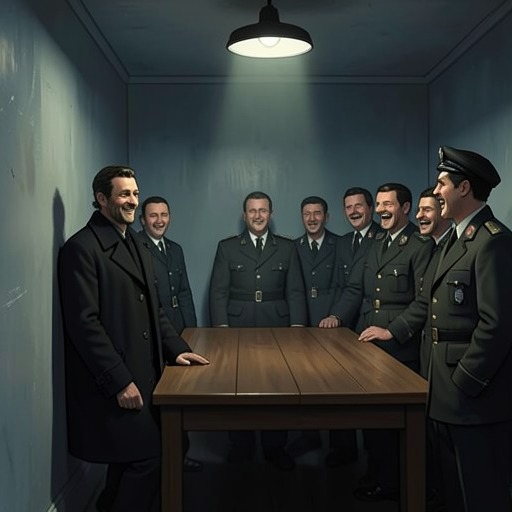
Doll later goes straight to Zulz after being warned about lice. Lying beneath a strong light on a table, he asks whether he may have Fleckfieber. Zulz tells him the situation could have been serious and that he is lucky. The brief exchange restores the familiar doctor-patient arrangement: Doll, normally the camp commander, is vulnerable on the examination table, while Zulz can offer a medical judgment. It does not establish what treatment follows, but it reinforces Zulz’s position as a source of professional authority to Doll.
Significance
Zulz’s defining contradiction is not simply that a physician takes part in a murderous institution. The novel also shows how he makes knowledge, credentials, and reassurance serve that institution. His statistics convert the education of perpetrators into a boast; his medical team participates in selection; and his advice about the bullhorn concerns how to manage deception when it no longer works. At the same time, his recommendation that Doll leave the ramp recognizes a human cost among the administrators without questioning the cost imposed on the people arriving there.
The distinction matters. Zulz can notice distress, speak in the language of healing, and still remain a functionary of violence. His concern for Doll is real as an action within their relationship, but it is bounded by their shared work: he offers rest from the ramp, not resistance to what happens on it. In that boundary, the character’s learning and medical standing become part of the book’s larger indictment of expertise severed from moral responsibility.